Thursday, March 31, 2005

That Have Not Been Asked: 7

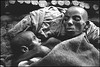
salgado+sahel+1985
From John Berger's essay "That Have Not Been Asked" with photographs by Sebastião Salgado.
“Whilst the rich drank tea and ate mutton, the poor were waiting for the warmth and for the plants to grow.”

The difference between seasons, as also the difference between night and day, shine and rain, is vital. The flow of time is turbulent. The turbulence makes life-times shorter – both in fact and subjectively. Duration is brief. Nothing lasts. This is as much a prayer as a lament.

(The mother) was grieving that she had died and forced her children to mourn for her; if she could have, she would have gone on living forever so that nobody should suffer on her account, or waste, on her account, the heart and the body to which she had given birth....but the mother had not been able to stand living for very long.”
Death occurs when life has no scrap left to defend.

Not Playing The Game

gary+sobers viv+richards michael+holding
For as long as I can remember the West Indies has been my cricket team. This affinity had more to do with accident than design. When we moved to England we lived not far from The Oval and it was there, sitting in front of the gasholders, that I first saw Gary Sobers and Rohan Kanhai, Wes Hall and Lance Gibbs: names to conjure with. To be part of that South London crowd – at least half of whom must have been first- and second-generation Caribbean settlers – was a wonderful education. Kanhai hooking into the crowd off bended knee, and then blocking the next ball with due care and attention: "Tell him no, man!" The days of Clive Lloyd's ruthless winning machine were still years off but I knew what I liked and the WIndies rarely disappointed. And then a succession of greats and their never-to-be forgotten performances – Viv Richards's stamp of genius in 1976 or Michael Holding's deadly beauty at a parched Oval that same year, Gordon Greenidge's swaggering authority at Lord's in 1984 or Malcolm Marshall's heroics four years later.


All great teams rise and fall (though I'm not sure the current Aussie team is quite ready to call it a day). But the fall of West Indies cricket from its elevated state of grace has been evident since the mid-1990s and shows no sign of reversing any time soon. For a while the real depth of the decline was masked by the efforts of three wonderful players – Brian Lara, Curtley Ambrose and Courtney Walsh. The two fast bowlers have gone now and Lara remains a troubled and troubling presence.

All kinds of reasons have been put forward for the decline. Some blame the influx of satellite dishes and cable companies, leading to the saturation of American sports on television. Others point to the changing economies in the Caribbean making cricket too time consuming and expensive to play. The West Indies Cricket Board has also been castigated for not planning sufficiently for the future. Or maybe it is just the cyclical nature of sport. Perhaps the most brutal assessment comes from Hilary Beckles, the doyen of Caribbean cricket historians. He blames the players:

You cannot get a more miserable, self-dividing people anywhere in the Caribbean like West Indian cricketers. It's a miserable community that cannot rise and take responsibility for their own craft.
If this seems harsh then the latest crisis to envelop the West Indies seems to bear him out. On the eve of an important home series against South Africa, half a dozen of the best players – including Lara – were not available for selection because of an unseemly dispute over sponsorship deals and money. The details are not important and it looks like a settlement might soon be reached. But the longer term omens are not at all good. Something is rotten in the state of West Indies cricket.

In today's Guardian, the Trinidadian writer B.C. Pires offers a sobering tale of "self-inflicted pride and prejudice". He is clear about the way in which today's impasse between the players, the Board and the sponsors is symptomatic of much deeper problems:
The root causes of the crisis are the same as they have always been in Caribbean cricket: the last three weeks of brinksmanship are only a reflection and inevitable consequence of years of decline, mismanagement, greed and insularity.
In particular, Pires says,
the accusation of greed is difficult to avoid... [all] have been plainly seeking to feather their own nests.
And his conclusion is especially bleak:
Against this barrage of negativity the West Indian population has been able to bring only hope. Up to yesterday Caribbeans were praying for a last-minute, miraculous resolution that would give them a team they could love as well as support. This morning many of them could be forgiven for thinking that, in the Caribbean in cricket at least, there is no future, just the past happening over and over again
Beyond the very obvious problems that have long beset Caribbean cricket I had always held on to the cyclical view of sporting decline and eventual revival – the West Indies' time would come again sooner or later. Now I am not so sure. What if there really is no future?

Wednesday, March 30, 2005

That Have Not Been Asked: 6

salgado+brazil+landless
From John Berger's essay "That Have Not Been Asked" with photographs by Sebastião Salgado.

The worst cruelties of life are its killing injustices. Almost all promises are broken. The poor’s acceptance of adversity is neither passive nor resigned. It’s an acceptance which peers behind the adversity and discovers there something nameless. Not a promise, for (almost) all promises are broken; rather something like a bracket, a parenthesis in the otherwise remorseless flow of history. And the sum total of these parentheses is eternity.

This can be put the other way round: on this earth there is no happiness without a longing for justice.

Happiness is not something to be pursued, it is something met, an encounter. Most encounters, however, have a sequel; this is their promise. The encounter with happiness has no sequel. All is there instantly. Happiness is what pierces grief.

We thought there was nothing left in the world, that everything had disappeared long ago. And if we were the only ones left, what was the point of living?

“We went to check”, said Allah. “‘Were there any other people anywhere? We wanted to know.”

Chagataev understood them and asked if this meant they were now convinced about life and wouldn’t be dying any more.

“Dying’s no use”, said Cherkezov. “To die once – now you might think that’s something necessary and useful. But dying once doesn’t help you to understand your own happiness – and no one gets the chance to die twice. So dying gets you nowhere.”

Ten Of The Best

books
One of the best things about passing on the stick of the recent book survey is the chance to follow up on other bloggers' choices. From this partial spider's web I have selected just one of the deserted island titles from each of the respondents. I will pursue them over the coming weeks. It's also a nice way of highlighting some of blogs I read regularly.

From Saheli: W.G. Sebald's The Rings Of Saturn
From Michael: Edward Abbey's The Monkey Wrench Gang
From Norm: George Eliot's
Middlemarch (Proust is just too daunting)
From Anne: Milton's Paradise Lost
From Hak Mao: Victor Serge's The Case Of Comrade Tulayev
From Darren: Edward Gaitens's The Dance Of The Apprentices
From Douglas: Stendhal's Le Rouge et Le Noir
From Stuart: Upton Sinclair's The Jungle
From Richard: Isaac Bashevis Singer's Collected Stories
From Joseph: Iain M Banks's Against A Dark Background
Well that lot should keep me busy.

Tuesday, March 29, 2005

That Have Not Been Asked: 5

salgado+girl+story
From John Berger's essay "That Have Not Been Asked" with photographs by Sebastião Salgado.

The secret of storytelling amongst the poor is the conviction that stories are told so that they may be listened to elsewhere, where somebody, or perhaps a legion of people, know better than the storyteller or the story’s protagonists, what life means. The powerful can’t tell stories: boasts are the opposite of stories, and any story however mild has to be fearless and the powerful today live nervously.

A story refers life to an alternative and more final judge who is far away. Maybe the judge is located in the future, or in the past that is still attentive, or maybe somewhere over the hill, where the day’s luck has changed (the poor have to refer often to bad or good luck) so that the last have become first.

Story-time (the time within a story) is not linear. The living and the dead meet as listeners and judges within this time, and the greater the number of listeners felt to be there, the more intimate the story becomes to each listener. Stories are one way of sharing the belief that justice is imminent. And for such a belief, children, women and men will fight at a given moment with astounding ferocity. This is why tyrants fear storytelling: all stories somehow refer to the story of their fall.

Wherever he went, he only had to promise to tell a story and people would take him in for the night: a story’s stronger than a Tsar. There was just one thing: if he began telling stories before the evening meal, no-one ever felt hungry and he didn’t get anything to eat. So the old soldier always asked for a bowl of soup first.

Jimmy Smith And An Aomori Winter

winter+aomori+2 winter+aomori+1
Hisashi has a jazz programme on a local radio station in Hokkaido, northern Japan, and we've been writing to each other about Jimmy Smith
. He featured the great album The Sermon last Sunday. And, in passing, Hisashi sent me these two photographs: "I am sure they will remind you of what chilly days are like". I don't need reminding but they're nice shots.

The Morning After

Seismic+Activity
Obviously most people were talking about last night's earthquake though some friends, remarkably, managed to sleep through the whole thing. We are over 500km from the epicentre but the tremors were strong and prolonged, and there was a real sense of fear and bewilderment. The memories of 26 December are still fresh. Firsthand accounts of people's experiences of the earthquake can be found here while there are reports here, here, here and here. There are fears that 2,000 may have died with the small island of Nias taking the brunt. I am still waiting news of Mai Lin and her daughter, Sophie, in Kerinci, Sumatra. I simply hope they're safe.

Earthquake 'Round Midnight

It was around midnight. The city was quiet, bedding down for the night. And then came the now familiar feeling. Our tall apartment block started swaying – strong, deliberate trembling. The wooden wind chimes clashed discordantly; glasses on the draining board tinkled; the panicked voices of our neighbours betrayed rising alarm. 90 seconds is a very long time in an earthquake. You think about many things in that time. We hid for some seconds, perhaps half a minute, under the big wooden divan but, to me at least, that seemed to make us more vulnerable. "Let's get out of here". So we grabbed keys, shoes, and ran down the stairs – turning, turning on ourselves down sixteen stories. Halfway down I caught up with my friend Seth who was struggling to carry his son. He handed him over and I carried the small, sleeping boy – innocently unaware of the panic around him – deadweight in my arms. We reached the ground level where hundreds and hundreds had gathered on the street. Everyone knew it was another earthquake, another huge tremor, which must have come from Sumatra again. "Again" – it was the word on everyone's lips. Was it just three months ago? There's been a lot of seismic activity recently but nobody was expecting anything on this scale. We waited. Neighbours began to call friends elsewhere – there had been damage all over the country. Slowly the panic died as people murmured quietly to each other, consoling and grateful. Is this now to be a regular part of our lives? Will there be another tsunami? After an age we returned to the flat, switched on the television as the story broke across the world's media, telephoned friends. I suddenly think fiercely of my friend Mai Lin who is on an archaeological dig near Kerinci in the middle of Sumatra – I can only hope that she and Sophie, her little daughter, are safe tonight. I can only hope that everyone finds sanctuary in this dark tropical night.
Monday, March 28, 2005

That Have Not Been Asked: 4

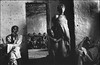
salgado+ethiopia+1984
From John Berger's essay "That Have Not Been Asked" with photographs by Sebastião Salgado.

From time to time despair enters into the lives which are mostly grief. Despair is the emotion which follows a sense of betrayal. A hope against hope (which is still far from a promise) collapses or is collapsed; despair fills the space in the soul which was occupied by that hope. Despair has nothing to do with nihilism.

Nihilism, in its contemporary sense, is the refusal to believe in any scale of priorities beyond the pursuit of profit, considered as the end-all of social activity, so that, precisely: everything has its price. Nihilism is resignation before the contention that Price is all. It is the most current form of human cowardice. But not one to which the poor often succumb.

He began to pity his body and his bones; his mother had once gathered them together for him from the poverty of her flesh – not because of love and passion, not for pleasure, but out of the most everyday necessity. He felt as if he belonged to others, as if he were the last possession of those who have no possessions, about to be squandered to no purpose, and he was seized by the greatest, most vital fury of his life.

[A word of explanation about these quotations. They are from the stories of the great Russian writer, Andrei Platonov (1899-1951). He wrote about the poverty which occurred during the civil war and later during the forced collectivisation of Soviet agriculture in the early 1930s. What made this poverty unlike more ancient poverties was the fact that its desolation contained shattered hopes. It fell to the ground exhausted, it got to its feet, it staggered, it marched on amongst shards of betrayed promises and smashed words. Platonov often used the term dushevny bednyak, which means literally poor souls. It referred to those from whom everything had been taken so that the emptiness within them was immense and in that immensity only their soul was left – that’s to say their ability to feel and suffer. His stories do not add to the grief being lived, they save something. “Out of our ugliness will grow the world’s heart”, he wrote in the early 1920s.

The world today is suffering another form of modern poverty. No need to quote the figures; they are widely known and repeating them again only makes another wall of statistics. Perhaps as much as a third of the world’s population live with less than $2 a day. Local cultures with their partial remedies – both physical and spiritual – for some of life’s afflictions are being systematically destroyed or attacked. The new technology and means of communication, the free market economy, productive abundance, parliamentary democracy, are failing, so far as the poor are concerned, to keep any of their promises beyond that of the supply of certain cheap consumerist goods, which the poor can buy when they steal.

Platonov understood living modern poverty more deeply than any other storyteller I have come across.]

Where Monsoons Meet No. 11

Tuol Sleng Museum of Genocide
Being a miscellany of recent stories from Southeast Asia.

  • Burma. A recent meeting of the International Labour Organisation stated categorically that "that no adequate moves have been taken by the Burmese military regime (the "Government" of Myanmar) to reduce forced labour in Burma/Myanmar". This follows last month's visit to the country by a very high-level team to reassess the labour situation. For an international organisation, the ILO's language is unusually forthright. Its Governing Body has "expressed grave doubts" about the junta's credibility in dealing with the forced labour issue and argued that the "wait-and-see" attitude that has been the norm for the last three years is no longer tenable. The responses of various ILO constituents to the situation in Burma has been mixed. Some governments - the US, Japan, the UK and Canada - have all adopted (relatively modest) sanctions. Many international and national workers' organisations have targeted the withdrawal of multinational corporations from Burma and called for an extension of sanctions. As far as business interests are concerned it's not surprising that the ILO says that "no specific information is available" though it does cite some disinvestment by individual companies. The ILO has given the Burmese junta a new deadline of June before taking any further steps. It shouldn't hold its breath.

  • Cambodia. There are real fears that the long-delayed quest for justice for the Cambodian genocide may founder because of a lack of funds. There have already been years of delay in setting up a tribunal and plenty of compromises along the way. Two years ago the United Nations has signed off on a formula to conduct the trials in Cambodian courts with international assistance; a draft tribunal law made its way through the Cambodian legislative process; and many of the prime suspects, with the exception of Pol Pot himself, who died in 1998, are within the reach of the courts. But there may not be enough money to get the tribunal process moving. The agreed budget is $56 million, mostly from the UN. But donors have been slow to come forward – to date only five countries have made pledges – and the Cambodian government says it can only meet one-tenth of its share. Youk Chang, of the Documentation Centre of Cambodia, offers this eloquent statement as to why the tribunal is vital: "It's important to understand that if we continue to delay the process, many survivors will die without seeing justice being done, and many prime suspects and perpetrators will die without being punished, which will be very difficult for many Cambodian people trying to move on with their lives". In international aid terms the amount needed is a pittance. And the reasons for the tribunal are compelling. Let's hope that the impasse can be broken. Some articles on the struggle for justice in Cambodia are available here from the excellent Cambodia Genocide Program at Yale.
  • Thailand. More than one month after the prime minister, Thaksin Shinawatra, imposed his hardline policy, the violence in southern Thailand shows no signs of abating. Yesterday, 22 people were injured in a train ambush at Sungai Padi near the Malaysian border. There are reports here, here and here. As things stand at the government simply has no policy to deal with the causes of the rebel movement still less its horrible consequences.

Sunday, March 27, 2005

That Have Not Been Asked: 3

salgado+brazil+landless
From John Berger's essay "That Have Not Been Asked" with photographs by Sebastião Salgado.

The lives of the poor are mostly grief, interrupted by moments of illumination. Each life has its own propensity for illumination and no two are the same. (Conformism is a habit cultivated by the well-off.) Illuminated moments arrive by way of tenderness and love – the consolation of being recognised and needed and embraced for being what one suddenly is! Other moments are illuminated by an intuition, despite everything, that the human species serves for something.

“Nazar tell me something or other – something more important than anything.”

Aidym turned down the wick in the lamp in order to use less paraffin. She understood that, since there was something or other in life that was more important than anything, it was essential to take care of every good that there was.

“I don’t know the thing that really matters, Aidym,” said Chagataev. “ I haven’t thought about it, I’ve never had time. But if we’ve both of us been born, then there must be something in us that really matters.”

Aidym agreed: “A little that does matter... and a lot that doesn’t.”

Aidym prepared supper. She took a flat bread out of a sack, spread it with sheep’s fat and broke it in half. She gave Chagataev the big half, and took the small half herself. They silently chewed their food by the weak light of the lamp. In the Ust-Yurt and the desert it was quiet, uncertain and dark.”

Tens Of Thousands Of Stories

GunesekeraRomesh
Yesterday I wrote about the
tsunami and remembrance. I ended the piece like this:
But the individual stories still matter: they are the personal and existential realities of death and loss, of survival and hope, of frailty and strength.
The Guardian has a long essay by the novelist Louise Doughty who has visited Sri Lanka and asked the island's writers and artists whether thay can play a part in the process of recovery. She gathers some very perceptive reflections from her interviewees. Here is the playwright and filmmaker Delon Weerasinghe:
The tsunami wasn't a story. It was tens of thousands of stories. No novel or play could possibly do justice to that. No single fiction could represent the multiplicity of experiences which this country went through, never mind elsewhere.
And here is Romesh Gunesekera on the writer's need to write even in the face of appalling events:
Most writers are dealing with the world they live in ... a world in which terrible things have happened and are still happening. Writing is not a matter of duty, it is more a kind of negotiation with different realities. We each do it in our own way and perhaps don't have much choice in how or what we end up writing.
There are lots of other insights into Sri Lanka's rich literary life and the rest is worth reading.

Saturday, March 26, 2005

The Passion Of The Cricket Crowd

india+pakistan+mohali
Mike Marqusee has a short essay here on watching cricket in India at the recent India–Pakistan test match at Mohali. Actually it's a celebration of the crowd:
A cricket crowd is a complex organism, a throbbing mass with a life of its own. It’s rarely static. In the course of a day’s play it undergoes paroxysms of joy and despair, intervals of humour, bouts of nastiness and periods of boredom. Sometimes it’s fractious, bickering with itself. Sometimes it’s unanimous - astonishingly, if briefly, it really does seem to feel like 'one soul', filled with a single emotion.
Not quite Lord's, but this is South Asia where cricket is still the people's game despite the penetration of the media and celebrity culture. Mike also sees some signs of hope that India versus Pakistan may be transforming into a normal sporting contest and not simply an excuse for hatred. He spots this on a banner:
Bat and ball is a lot better than assault rifle and grenade.
The photo (above) tells the same story. Read the rest.

"I Can Sing The Top Of A Song"

billie+2
Just the other day I posted about Billie Holiday's version of "Gloomy Sunday" and then I come across this in today's Guardian. In advance of her book, With Billie, Julia Blackburn offers a taster on Lady Day's life by those who knew her. What comes through, she says, is not Billie the victim but a woman of remarkable strength in the face of adversity.
Initially, I thought I was going to write a biography, but what I have ended up with is something more like a documentary. Instead of trying to produce a unified account of Holiday's life, I have let some of the most interesting or eloquent speakers tell their own story of who she was and what she meant to them. As I worked with these interviews I began to see a very different person to the drug-riddled victim of her own vices so often and so flippantly described on CD covers and elsewhere.
Here are some extracts from Blackburn's essay that give a sense of Billie Holiday's personalities and priorities:

Pianist Bobby Tucker:
He remembered the occasion when she was being presented with an award and the house lights were suddenly turned on and "she literally froze, her voice was shaking, she was trembling". This fear was always visible to the people who knew her well, but it was part of her strength, part of the energy of concentration. She said: "The time when you go out there on stage and you're not nervous, that's when you're gonna stink."
Stump Daddy:
Lady Day was a tremendous mental musical being. She knew about the creative value of music. She'd come out of the sky with something and she could crack your skull with a riff.
Pianist and composer Irene Kitchings:
Once Billie got big, it didn't matter to her. All she wanted was to have some decent music to accompany her and the people to be quiet and listen to her sing... Singing was all she knew how to do. That's all that made her real happy.
And finally Billie herself:
I've got stories about music and that means I can sing the top of a song.
Read the rest.

That Have Not Been Asked: 2

salgado+vietnam+refugee
From John Berger's essay "That Have Not Been Asked" with photographs by Sebastião Salgado.

The poor have no residence. They have homes because they remember mothers or grandfathers or an aunt who brought them up. A residence is a fortress, not a story; it keeps the wild at bay. A residence needs walls. Nearly everyone among the poor dreams of a small residence, like dreaming of rest. However great the congestion, the poor live in the open, where they improvise, not residences, but places for themselves. These places are as much protagonists as their occupants; the places have their own lives to live and do not, like residences, wait on others. The poor live with the wind, with dampness, flying dust, silence, unbearable noise (sometimes with both; yes, that’s possible!) with ants, with large animals, with smells coming from the earth, rats, smoke, rain, vibrations from elsewhere, rumours, nightfall, and with each other. Between the inhabitants and these presences there are no clear marking lines. Inextricably confounded, they together make up the place’s life.

Twilight was setting in; the sky wrapped in cool grey fog, was already being closed off by darkness; and the wind, after spending the day rustling stubble and bare bushes that had gone dead in preparation for winter, now lay itself down in still low places on the earth...
The poor are collectively unseizable. They are not only the majority on the planet, they are everywhere and the smallest event speaks of them. This is why the essential activity of the rich today is the building of walls – walls of concrete, of electronic surveillance, of missile barrages, minefields, frontier controls, and opaque media screens.

Tsunami Stories And Remembrance

aceh+women+survivors
It's exactly three months since the earthquake-tsunami catastrophe struck the Indian Ocean. There has been, during that time, a huge amount of reflection and commentary on almost every conceivable aspect of the disaster. Not unnaturally, perhaps, the focus of most media outlets have moved on – it's the unremitting logic of presentism in the news agenda.

But some websites have done an excellent job in reminding us of the lives of the survivors and of the ongoing struggle for recovery and reconstruction. In the fickle world of news manufacture this is a necessary effort of remembrance.

To its credit the BBC has consistently updated its coverage of post-tsunami stories and I highlight some of the recent ones here. As you'd expect they are a mixture of the hopeful and the disturbing:
  • Everyone was, I think, moved by the generosity of ordinary people in raising huge amounts of money for the tsunami victims. Doubts were aired, however, over the pledges made by rich countries and with good reason. This report says that there is a $4 billion shortfall in promised donations. It's based on a recent Asian Development Bank report on reconstruction which, among other things, highlights the need for coordination mechanisms and means for combating corruption.
  • There is a moving photo essay here on the efforts of Alana McGowan – who lost her sister and nieces when the tsunami hit the Thai island of Phi Phi – to set up a nursery for surviving children, who now live in camps in the mainland town of Krabi.
  • This report links the plans for reconstructing Aceh to the hopeful negotiations between the Indonesian government and the Free Aceh Movement (GAM) though, as it points out, there are signs that the informal truce on the ground is fraying.
  • Less hopefully, the United Nations' refugee agency has announced its withdrawal from Aceh ahead of new restrictions on foreign aid agencies undertaking emergency relief in the region. The Indonesian government is uncomfortable with UNHCR's highlighting of human rights abuses by the military.
  • Most attention has been paid to the physical and material aspects of reconstruction but there are enduring psychological problems affecting mental health. Trauma, stress and guilt are just some of the more obvious signs. Children, in particular, will need long-term counselling and support.
  • A couple of reports here and here highlight the gender impact of the tsunami. There is staggering evidence from an Oxfam report that four times as many women than men may have been killed in some regions. As the report argues: "disasters are disciminatory" and renewed efforts will have to be made to integrate this horrible reality into relief efforts. The fishermen widows of Sri Lanka are simply not coping with the loss of women in their communities.

Remembrance is a social process, while memory, both individual and collective, is its product. Collective remembrance, the process of public recollection of the kind contained in these stories and thousands of others, is the act of those people who gather bits and pieces of the past and join them together for a public – for you and me – who will express, reflect upon and consume that memory. As in all catastrophes, the whole is greater than the sum of the parts. But the individual stories still matter: they are the personal and existential realities of death and loss, of survival and hope, of frailty and strength.

Friday, March 25, 2005

That Have Not Been Asked: 1

salgado+plume
From John Berger's essay "That Have Not Been Asked" with photographs by Sebastião Salgado.
The wind got up in
the night and took our plans away.

(Chinese proverb)

Thursday, March 24, 2005

John Berger And Sebastião Salgado

sebastião+salgado
The celebration of John Berger's work – called "Here Is Where We Meet" – opens in London in a couple of weeks. As a way of acknowledging that celebration, and as a way of reflecting on some of my recent posts on the Victims Of The Metropolis or The Agony Of Toil, I am posting, daily, excerpts from John Berger's recent essay "That Have Not Been Asked" from openDemocracy. Its themes are
poverty, desire, storytelling, and the future’s gift to the present. It comes in "ten dispatches".

I will be illustrating the essay with photographs by Sebastião Salgado who has a long association with Berger. In lieu of a preface to the new essay, here is Berger writing on Salgado and his collection, Migrations:

In a strange way, in all these pictures, one feels in Salgado's vision the word "yes" - not that he approves of what he sees, but that he says "yes" because it exists. Of course he hopes that this "yes" will provoke in people who look at the pictures a "no", but this "no" can only come after one has said, "I have to live with this." And to live with this world is first of all to take it in. The opposite is indifference.

The point about hope is that it is something that occurs in very dark moments. It is like a flame in the darkness; it isn't like a confidence and a promise.

In the 1940s the French philosopher Simone Weil wrote this – a kind of summing up, I think, of what Salgado was saying: "There are only two services that images can offer the afflicted. One is to find the story that expresses the truth of their affliction. The second is to find the words that can give resonance, through the crust of external circumstances, to the cry that is always inaudible: "Why am I being hurt?"

There's an excellent website on Sebastião Salgado's work here. John Berger's own work is like that same "flame in the darkness". We should cherish him as our own.

Wednesday, March 23, 2005

A Little Gentle Flogging

glass+penal+colony
I would normally agree that the term "Kafkaesque" is overused. But I can't for the life of me think of anything more appropriate to describe what's going on in Malaysia's immigration saga. Think of In The Penal Colony ... and you'll get the point.

A little recap may be order for those of you who've not been following. Last year the Malaysian authorities decided to expel hundreds of thousands of undocumented migrant workers, mainly drawn from Indonesia and the Philippines. The usual xenophobic nonsense is used to justify the move. Then on 26 December the earthquake-tsunami catastrophe strikes – devastating Aceh, killing hundreds of thousands and making millions homeless and jobless. The Malaysian government pushes on with its deportation plans though the deadline is moved in response to pleas from the Indonesian and Philippine governments and Malaysian NGOs. The punishments for over-stayers are, by any account, draconian: fines, imprisonment and floggings. The 1 March deadline arrives with few having already left the country while many migrants go into hiding. Malaysian government spokesmen go on record to say that even asylum seekers and refugees will be targeted in contravention of the country's international legal undertakings. Over the last month perhaps 500,000 workers have been forced out. And now comes this.

The same politicians who ordered the deportations are now convening a cabinet meeting to discuss ... the labour shortage in crucial sectors of the economy:
factories, restaurants, construction sites and palm oil plantations where many Malaysians simply don't want to work. So they're now turning their attention to recruiting from South Asia and especially from Pakistan. But some critics are worried that the new migrant workers may have Islamist links to al-Qaeda. This one could run and run.

Meanwhile, Malaysia's executioners and floggers are about to see their performance-related pay rise by over 300%. As the BBC puts it:
With threats to flog an estimated half a million illegal migrants thought to be hiding in Malaysia, prison officers could be in for a major windfall.
In case you're thinking of applying for a job I'd better give you the new improved rates: 10 ringgit ($2.60) for each blow with the bamboo rotan – and foreigners convicted of immigration offences can be given up to six beatings. Nice work if you can get it. But be warned, according to the prison service the competition is tough:
flogging jobs are hotly contested, with only one in five applicants being accepted. The service says only hardened staff are suitable.
In case migrant workers are trembling at the prospect of overpaid psychopaths beating ten shades of crap out of them they should just chill a little:
[T]he government has stressed that illegal migrants will be flogged gently.
Where's the little Bohemian scribbler when you need him?

Oiling The Junta

anti+unocal
I preface this post with these powerful words from
Aung San Suu Kyi:
To observe businessmen who come to Burma with the intention of enriching themselves is somewhat like watching passers-by in an orchard roughly stripping off blossoms for their fragile beauty, blind to the ugliness of despoiled branches, oblivious of the fact that by their action they are imperilling future fruitfulness and committing an injustice against the rightful owners of the trees.
Recently, I reported on the unsuccessful bid by millions of Vietnamese to sue the manufacturers of Agent Orange for the persistent and horrific effects of those toxic chemicals. That case is set to go to appeal. But there is marginally better news today for Burmese villagers who have been fighting an 8-year court case against the US oil firm, Unocal. In an unspecified out-of-court settlement Unocal has agreed to compensate villagers who suffered severe abuses during the construction of a gas pipeline. Here is the crux of the matter:
It was accused of allowing Burmese troops guarding the project to rape, murder and enslave villagers.
This is not simply an isolated case of "rotten apples". It is absolutely sympomatic of the way that the military junta does business. For many years now there has been verifiable evidence of gross human rights abuses, including the forcible relocation of civilians and the widespread use of forced labour, including children, precisely for these projects with multinational corporations. All this is well known. But companies like Unocal still choose to sup with the devil. They just don't get it. And despite the settlement Unocal strongly denies any part in human rights abuses. The money, by the way, will be spent on development "to improve living conditions, health care and education, and protect the rights of people from the pipeline region". But it's hard to see how people will protect themselves from these military thugs.

But just as the Unocal case reaches its conclusion so the campaign against the French oil giant, TOTAL, gathers pace. The Burma Campaign UK has recently published a comprehensive report on TOTAL's dealings with the Rangoon goons:
the fourth largest oil company in the world and one of the biggest foreign investors in Burma. Its joint venture with Burma's dictatorship earns the military regime hundreds of millions of dollars every year.
And for those of you who think that the French government has some higher moral legitimacy than other governments you may think about, ponder this:
[T]ougher European Union sanctions against Burma have been blocked by the French government in its effort to protect TOTAL's interests in the country.
For years now, big capital has been drip-feeding this obnoxious regime; not just Western companies but those from China and India as well. "Constructive engagement" is a lie; "bringing 'development' to the people" is a lie. As that one-time chronicler of Burmese Days would have put it, it's all "doublespeak". Aung San Suu Kyi says "no" to these injustices. That should be good enough for us.

Tuesday, March 22, 2005

Singing The Blues

Billie+Holiday
Tomorrow night we're screening Rolf Schubel's film Ein Lied von Liebe und Tod (A Song Of Love And Death), with a review to follow. The English language version uses the title Gloomy Sunday, named for the song that Billie Holiday made famous. When I first saw the film I was enchanted with how the song is used and discovered, to my surprise, that it was a very popular Hungarian song of the 1930s (the setting for the movie). A little bit of digging allowed me to understand its reputation as the lovers' "suicide song". Here's the story.

Gloomy Sunday - the notorious 'Hungarian Suicide Song' - was written in 1933. Its melody and original lyrics were the creation of Rezsô Seress, a self-taught pianist and composer born in Hungary in 1899. The crushing hopelessness and bitter despair which characterised the two stanza penned by Seress were superseded by the more mournful, melancholic verses of Hungarian poet László Jávor.

When the song came to public attention it quickly earned its reputation as a 'suicide song'. Reports from Hungary alleged individuals had taken their lives after listening to the haunting melody, or that the lyrics had been left with their last letters.

The lyricists Sam M. Lewis and Desmond Carter each penned an English translatation of the song. It was Lewis's version, first recorded by Hal Kemp and his Orchestra, with Bob Allen on vocals (1936), that was to become the most widely covered.

The popularity of Gloomy Sunday increased greatly through its interpretation by Billie Holiday (1941). In an attempt to alleviate the pessemistic tone a third stanza was added to this version, giving the song a dreamy twist, yet still the suicide reputation remained. Gloomy Sunday was banned from the playlists of major radio broadcasters around the world. The BBC deemed it too depressing for the airwaves. Despite all such bans, Gloomy Sunday continued to be recorded and sold.

People continued to buy the recordings; some committed suicide. Rezsô Seress jumped to his death from his flat in 1968.
Naturally, I decided to check out the lyrics that seemed to have had such a powerful effect. See what you think:

Rezsô Seress version (in translation)

All love has died on earth
The wind is weeping with sorrowful tears
My heart will never hope for a new spring again
My tears and my sorrows are all in vain
People are heartless, greedy and wicked...

Love has died!

The world has come to its end, hope has ceased to have a meaning
Cities are being wiped out, shrapnel is making music
Meadows are coloured red with human blood
There are dead people on the streets everywhere
I will say another quiet prayer:
People are sinners, Lord, they make mistakes...

The world has ended!
László Jávor version (in translation)
Gloomy Sunday with a hundred white flowers
I was waiting for you my dearest with a prayer
A Sunday morning, chasing after my dreams
The carriage of my sorrow returned to me without you
It is since then that my Sundays have been forever sad
Tears my only drink, the sorrow my bread...

Gloomy Sunday

This last Sunday, my darling please come to me
There'll be a priest, a coffin, a catafalque and a winding-sheet
There'll be flowers for you, flowers and a coffin
Under the blossoming trees it will be my last journey
My eyes will be open, so that I could see you for a last time
Don't be afraid of my eyes, I'm blessing you even in my death...

The last Sunday
Sam M. Lewis version (in the original and Billie Holiday's lyrics)
Sunday is gloomy, my hours are slumberless
Dearest the shadows I live with are numberless
Little white flowers will never awaken you
Not where the black coach of sorrow has taken you
Angels have no thought of ever returning you
Would they be angry if I thought of joining you?

Gloomy Sunday

Gloomy is Sunday, with shadows I spend it all
My heart and I have decided to end it all
Soon there'll be candles and prayers that are sad I know
Let them not weep let them know that I'm glad to go
Death is no dream for in death I'm caressing you
With the last breath of my soul I'll be blessing you

Gloomy Sunday

Dreaming, I was only dreaming
I wake and I find you asleep in the deep of my heart, here
Darling, I hope that my dream never haunted you
My heart is telling you how much I wanted you

Gloomy Sunday

The Victims Of The Metropolis

makoko
Where are the heroes, the colonisers, the victims of the Metropolis?
Brecht, Diary entry, 1921
It's been about twenty years since I first saw Ajegunle for the one and only time. I was young and just beginning an extended period of fieldwork in Nigeria. I stayed in Lagos for a few days and went to Ajegunle (known locally as "Jungle City") with Tunde, a social activist. Nothing, absolutely nothing, could have prepared me for what I witnessed: the utter pity of human deprivation where people - hundreds of thousands of people - somehow eked out the conditions of survival.

In his brilliant essay on the South's Planet Of Slums, Mike Davis quotes Dickens:
I saw innumerable hosts, foredoomed to darkness, dirt, pestilence, obscenity, misery and early death.
In part, some of today's slums have recapitulated the early experiences of unfettered industrialisation. But others, like those in Lagos, confound this link. Slums exist despite the absence of industrialisation with economies broken apart by catastrophic economic primitivisation and market anarchy.

I was reminded of this formative experience by a recent piece written by John Vidal, headlined "Everyone here wakes up angry" - the words of the Lagos poet and activist, AJ Daga Tola. AJ goes on:
Everyone here wakes up in anger. The frustration of being alive in a society like this is excruciating. People find it very hard and it is getting worse. Day in, day out, poor people from all over Africa arrive in this place, still seeing Lagos as the land of opportunity. They are met at the bus stops by gangs of youths who demand payments. There is extortion at every point. Only one in 10 people have regular work.
Vidal offers us an exemplary piece of first-hand reporting. And he provides a much-needed reality check against the pieties and platitudes of the Commission for Africa's recent report. There is plenty of evidence here that the Commission's rhetoric will not be matched by action if recent policies are anything to go by: the niggardly attitude of the G8 and World Bank; the absence of any serious plan for debt relief (Nigeria has paid its debts twice over and still owes $67 billion); the multilateral institutions promoting still more disastrous privatisation schemes; and so on.

Why has this happened? A recent report of the United Nations' Human Settlements Programme offers a partial answer. Its findings move beyond the usual circumspection ofUN reports and lay the blame squarely on the policies of neoliberalism.
The primary direction of both national and international interventions during the last twenty years has actually increased urban poverty and slums, increased exclusion and inequality.
It's neoliberalism they're talking about, not "bad governance" or "cultural failings" or the usual excuses. And yet, despite all the evidence, the Commission for Africa offers nothing but more of the same. The result is already the global catastrophe of urban poverty. Today, Lagos is the node of what Mike Davis calls "probably the biggest continuous footprint of urban poverty on earth". The Commission's policy prescriptions will likely make things worse.

In the face of this stark reality, the "planet of slums", something urgent and proundly radical needs to be done. A new politics and a new sense of social action will have to be framed by and for the wretched of the earth. The Left has, by and large, shirked its responsibility to the world's informal proletariat whose organisational spaces are the marketplace and slum streets, not the factory floor. Grassroots activists like AJ offer some hope for change as do examples from elsewhere. Once, in the nineteenth cetury, the great movements for working class emancipation came from the fetid industrial cities. In the twenty-first century will a new movement for emancipation spring from the victims of the dystopian metropolis?

Monday, March 21, 2005

Book Survey Meme

José+Saramago
Michael at Heliolith
has really put me on the spot. He's passed on to me this book survey meme which came to him via Saheli which came to her via .... I was thinking of passing on this but couldn't get it out of my mind. So here goes (but fiction only).

You're stuck inside Fahrenheit 451, which book do you want to be?
Which bought to mind the famous words Ray Bradbury offers Faber: "Do you know why books such as this are so important? Because they have quality. And what does the word quality mean? To me it means texture. This book has pores". So a book with texture and that breathes? Love In The Time Of Cholera by Gabriel García Márquez, the hope for love amid its own folly, imprecision and lapses.

Have you ever had a crush on a fictional character?
Who hasn't? Some recent examples: Both Naoko and Midori in Norwegian Wood by Haruki Murakami; Natalia Manur in The Man Of Feeling by Javier Marías; Fermina Daza in Love In The Time Of Cholera by Gabriel García Márquez.

The last book you bought is:
Kafka On The Shore by Haruki Murakami.

The last book you read:
The Plot Against America by Philip Roth

What are you currently reading?
The Double by José Saramago and The Shape Of A Pocket by John Berger.

Five books you would take to a deserted island
The Life And Opinions Of Tristram Shandy, Gentleman by Laurence Sterne.
As I Lay Dying by William Faulkner.
The Plague by Albert Camus.
Memory Of Fire Trilogy by Eduardo Galeano (Genesis; Faces And Masks; Century Of The Wind).
Blindness by José Saramago.

Who are you going to pass this stick to (3 persons) and why?
Bonn at A Good Game: because he'll spring some surprises.
The feline at Hak Mao
: because she'll be pithy and perhaps scabrous.
Norm at normblog
: because he likes this kind of thing.

Sunday, March 20, 2005

A Long, Long Wait

shane+williams
When Wales beat England at the start of the Six Nations I smiled quietly - but did not get overexcited. There have been plenty of false dawns over the years. In any case, the game against France would be the one. And so it proved; the best game of the whole championship by far and a sign of the times. Well, we can now celebrate the first Welsh grand slam for twenty-seven years. And the boys played with such verve: quick hands, intelligent running, instinctive support and plenty of insouciance. The current team can't yet compare with their 1978 ancestors; that team had already achieved greatness but was on the verge of breaking up. The 2005 team still has so much potential.


In his own tribute, Norm surprised me by pinning his flag to the Welsh mast - I never knew. But since he's in the mood for revealing sporting affinities here are mine: Wales at rugby (my dad wouldn't have it any other way), West Indies at cricket (Sobers and Kanhai at The Oval as a kid), and, um, Colchester United at football (the first game after we arrived in England was at Layer Road and we did once famously beat Leeds United in the Cup).

Big Mac Economics

mac+econ
From Pierre-Antoine Delhommais in Le Monde (no link):

In Nairobi it takes three hours' work to earn enough to buy a Big Mac, compared with five minutes in Miami. An employee in Mumbai must work for 89 minutes to afford a kilo of rice, against just five minutes in Switzerland.
I'm not sure why anyone would want to buy a Big Mac but you get the point.

No Pain With Game

baldur's+gate
My friend Marwan keeps telling everyone about the educational and therapeutic effects of computer games. He's addicted. Let's say I'm a bit sceptical. I always thought that games were sloth-inducing, violence-promoting excuses for a real life. But it seems he may have a point. A few months ago it was reported that games
can be used in the classroom to help children learn concepts such as critical appreciation of narrative structure or character development which they might otherwise study in a novel.
I'll have to ask him about the parallels between Baldur's Gate and the multiple narratives of Faulkner's As I Lay Dying. And now comes this: advice that a hefty dose of computer gaming can help patients overcome their pain. The report says that
children distracted in a virtual world of guns and mean monsters experienced less pain that those given only painkillers.
Perhaps that's why Marwan always goes round with a grin on his face.

Friday, March 18, 2005

Singapore: "This Vile Isle"

singapore+censorship
There is a new blog here coming out of Singapore. Posting at No Concept Of Liberty has been a bit fitful so far but suggestive of good things to come. There have already been reflections on life in the military, the "Asian Values" debate and the general state of Singapore's politics. Reading these insights also prompted a few thoughts of my own on what No Concept calls "this vile isle" (where, incidentally, I was born).

Modern Singapore has always struck me as embodying the worst of all possible worlds, a small-scale exemplar of authoritarian liberalism. It has a political system, overwhelmingly dominated by the People's Action Party, the forecloses almost any possibility of political dissent through comparatively sophisticated legalistic and cooptive methods of control.
Here is Gary Rodan's take on how Singapore's ruling classs is constantly engaged in the process of change in order to maintain control:
Historically, this included some crude forms of intimidation of political adversaries and critical elements of the media by invoking the Internal Security Act (ISA), under which people can be held indefinitely without trial. However, the more pervasive and definitive features of authoritarianism in Singapore involve a sophisticated and systematic combination of legal limits on independent social and political activities on the one hand, and extensive mechanisms of political cooptation to channel contention through state-controlled institutions on the other. This suppression of a genuine civil society not only fundamentally hampers the PAP's formal political opponents, it generally blunts political pluralism, including interest group politics. The PAP's political monopoly is rationalized through an elitist ideology, which depicts government as a technical process that mst be the preserve of a meritocracy.
Meanwhile, Singapore's economy has always been "open", deeply inserted into successive circuits of global capital – high-end manfacturing, services, information and communications – the broker between the regional economies and the rest of the world. It seems to me that Singapore offers the best possible institutional shell – on behalf of capital – for managing the current tensions and contradictions of the global political economy. It's an amalgam of highly attenuated political freedoms coupled with a regulatory state that promotes all the usual shibboleths for growth (innovation, technology, competitiveness, and the rest). Rodan calls it a model for "profits and censorship".

But this emergent form of authoritarian liberalism is not confined to Singapore alone. Marx famously said that "the country that is more developed industrially only shows, to the less developed, the image of its own future". And that is how I think we should read Singapore's long term significance: for countries like China and Vietnam look explicitly to Singapore as a model for managing their own radical transformations. No Concept Of Liberty captures the implications for Singaporeans – or at least those not captivated entirely by the cult of complacency and consumerism – in the following terms:
victims as we are of MINDEATH, a muzzled press and a state that treats us as means and not as ends.
Read some more, as they say.

Thursday, March 17, 2005

695,010,997th

Rich+Poor
Apparently, I'm the
695,010,997th richest person in the world; that puts me in the top 11.58%. Oh yes, it also means that there are 5,304,989,003 poorer than me. How do I know? Try here. It's pretty sobering.
(Via: Pas au-delà)

Joining The Band Of Five

Sachin+Tendulkar
The little master joined a pretty exclusive club today: Sunil Gavaskar, Allan Border, Steve Waugh, Brian Lara and now Sachin Tendulkar – the five who have scored 10,000 test runs. It's quite an achievement: the same number of innings as Lara and an average considerably better than the others at 57.80. I've only seen him batting twice: in a one-day international against England in 1996 when he was dismissed for a single; and amid the cacophony of the India vs Pakistan World Cup game at Old Trafford in 1999 when he scored a solid 45. So I've never seen him at the top of his form. But there's no doubt that he is one of the greats; Bradman thought of Tendulkar as the best of his generation.

There are tributes all over the place. But I especially like this piece of old-fashioned purple prose from Dileep Premachandran on the impact of the young Tendulkar:

Those innings embellished a legend that had its genesis on the dusty maidans of Mumbai school cricket, where he and his ebony-hued comrade, Vinod Kambli, had laid waste a string of run-scoring records. By the time Tendulkar was 15, Kapil Dev had bowled to him in the nets, while Sunil Gavaskar and Dilip Vengsarkar had already earmarked him for greatness.

As the years passed, more and more layers of delicate gold leaf – many against the all-conquering Australians – would add lustre to a cricketing deity quite unlike any seen before.
Over-the-top but he's been a truly wonderful player.

Wednesday, March 16, 2005

Patronising Africa (Again)

CfA
I have spent some time skimreading the report of the Commission for Africa,
Our Common Interest, and taking a hard look at the core chapters. The whole thing is downloadable here. I find the tone of report patronising in the extreme and the substantive recommendations to be little more than a thoroughgoing restatement of the usual "developmental" palliatives: governance and capacity-building; peace and security; investing in people; growth and poverty reduction; fairer trade. Fine words that mean very little in the context of a comprehensive model that embeds market dependence at every turn. Some commentators have picked up on the report's criticisms of institutions such as the IMF and World Bank as evidence that a new post-Washington Consensus is emerging, one that is more finely attuned to the real needs of Africa's people and is genuinely reformist. We should reject this argument. In fact, as is well known, both Bretton Woods institutions have been working hard over the last few years to frame an even more intrusive approach to capitalist development that focuses on social, political, cultural and institutional change as well as a continued commitment to "sound macro-economic principles". Our Common Interest is entirely consistent with this revised neoliberal agenda. And as almost everyone is aware, nearly all African people today are considerably poorer than they were twenty years ago precisely as a result of the consistent application of neoliberal austerity measures. Now the great and the good of the Commission want to extend and intensify these oppressive conditions.

Raj over at Class Worrier calls the report "this vile little document". Here's a flavour:

Tony Blair's Commission for Africa is a bunch of wank....

Actually, it's a great deal worse. It's precisely the kind of unctious toss that we've expected to spurt from Labour's glands. And, now that they've released this sticky little report, we can only hope that Blair will roll over, fart, and go to sleep. Not likely that he will though. More than anything, the Commission for Africa looks like it's a manifesto for yet more fiddling about with Africa, once again in the name of 'development'....


Wankers.
Couldn't have put it better myself.

Tuesday, March 15, 2005

More On Agent Orange

Vietnam+Child+Agent+Orange
Following up on my
post on Agent Orange, the excellent Kotaji has more on its use in Korea during the late 1960s, something that the US government denied for a long while. In relation to the civil case brought by millions of Vietnamese against the manufacturers of this deadly stuff, Ken Herrmann, who is director of the Da Nang/Quang Nam Fund which provides aid to children affected by exposure to Agent Orange, has gone on record to explain precisely what the plaintiffs are seeking:
They're asking for environmental clean-up; they're asking for medical care; they're asking merely for justice. Now, whether that will involve billions of dollars or whether it will involve a variety of corporations assisting in renumerating the harm that was done, I don't know that. But I do know that it is a matter of mere social justice.
Other blogs are covering this ongoing scandal and the fight for social justice here
and here.

There is also a very moving photo essay
by Manuel Navarro Forcada entitled "Vietnam 21st century: On the track of Agent Orange" at Fifty Crows here. The blurb says this:
[It] investigates the horrific persisting effects of the dioxin-contaminated herbicide used by the U.S. Air Force during the Vietnam War. Although Agent Orange was officially deployed to defoliate the tropical foliage of the region in order to render visible those beneath, dioxin exposure to humans has proven extremely harmful, if not lethal. By visiting hospitals, schools, and orphanages in Vietnam and documenting the many birth defects and malformations of children born in the thirty-year aftermath of the Vietnam War, Forcada’s photographs serve as solemn reminders of the atrocities of war. They are also a plea to rouse waning global interest in the war-torn legacy of Vietnam.
And then tell me you're not moved to action.

Monday, March 14, 2005

Where Monsoons Meet No. 10

pregnant+
Being a miscellany of recent stories from Southeast Asia.

  • Philippines. The story of the deaths of 27 schoolchildren in Bohol was just too sad for words. They died after eating a snack of cassava roots which are likely to have been contaminated with a pesticide. The official statement of the Department of Health notes that: "It is very much possible that the food was prepared in an environment that was highly toxic and contaminated with chemical poisons and bacteria". My friend, Joe, has been in a friendly debate with me over how to regulate the millions of street vendors and he has a point. Ignorance, neglect and under-regulation have led to a needless tragedy. It is beyond words.
  • Taiwan. It was a great crime and there has been no redress. Taiwanese women who were forced to be sex slaves (or "comfort women" as they were euphemistically known) for the Japanese military during the Second World War are campaigning for Japan to take legal responsibility for the crime. They join women in many other countries – Korea, the Philippines, China, Indonesia, Burma, and the Pacific Islands – in seeking redress from the Japanese authorities. In a typical evasion of all moral responsibility the high court in Tokyo rejected the Taiwanese women's demand on the basis that the claims were filed many years after the abuse occurred. Neither has the Japanese government ever issued an apology or even a disclosure. The only successful conviction of Japanese officers was made in 1948 in the case of 35 Dutch women. There is an excellent website here, maintained by Chunghee Sarah Soh, on the so-called "comfort women". With the current climate of conservative nationalism in Japan and Koizumi's pandering to the militarist past there's little likelihood of an immediate change of heart from Tokyo. But this crime requires atonement in the lifetime of its survivors. As the campaigning lawyer, Karen Parker, said many years ago before the United Nations Commission on Human Rights:
    Fifty years is long time. It is a long time for these women to relive those awful rapes over and over and over again. Japan, your surviving victims are elderly, many if not most suffering from health consequences from your rapes. Do the right thing. Pay them.
  • Indonesia–Aceh. There is an interesting report here on the reconstuction effort in post-tsunami Aceh. Rachel Harvey suggests that we are at the beginning of the longer-term phase of rehabilitation. But as she points out there remains a great deal of suspicion of the actions of the Indonesian military who are building barracks-style camps across the province. And then there is the problem of compensation and relocation of devastated communities. Of course, all this is going on at the same time as talks on the secessionist struggle between the government and the Free Aceh Movement (GAM). Harvey concludes her report:
    After decades of imposing policies on the province, there is an opportunity here for the central government in Jakarta to show that it respects the wishes and aspirations of the Acehnese people. If taken, the blueprint could become part of efforts towards political as well as physical reconstruction in Aceh.
    It's a mighty big if ...

Normblog's Greatest Composers

Bach
Norm has just posted the results
of his latest poll – this one on the greatest classical composers – together with a brief commentary. Here is the top ten:
01 Beethoven
02 Mozart
03 J.S. Bach
04 Schubert
05 Chopin
06 Wagner
07 Mahler
08 Brahms
09 Haydn
10 Handel
As Norm says, there's no great surprise with the top three who were way ahead of the field. Overall, there's too much German romanticism for my taste and I have a real quibble with Wagner and Handel being there at all. Aside from Beethoven and Bach, my other three choices were Sibelius (16th place), Shostakovich (11th) and Monteverdi (not placed). Hey ... just listen to the Vespers of 1610 or Orfeo with an open ear and tell me he shouldn't be there ... an early music genius and genuine innovator.

Jazz In Malacca?

Baba+house+Malacca
I have just returned from a couple of days in Malacca. I've already written about the small, thriving
artists' colony there and took the chance to visit the studio and gallery of Tham Siew Inn who was excited to tell me about his new printing techniques. But the highlight was looking around some of the lovely nineteenth century Baba or Peranakan shophouses that are for rent or for sale. Some are renovated and show off the eclectic architectural styles that are the hallmark of historic Malacca, with Chinese and Dutch influences to the fore. Many others are in a state of disrepair. The shophouse is an interesting amalgam of public commercial space and private dwelling for an extended family. They invariably have a narrow frontage but can be up to 70 metres in depth – and the interiors usually contain inner courtyards, air wells and balconies to keep the heat at bay. The specific reason for my tour? I have a slightly crazy dream of opening a jazz café in Old Malacca and this was my first serious assessment of what kinds of spaces are available. I already have a name – "Naima" – for John Coltrane's famous tune and in memory of a dear friend. And I can already imagine the jazz licks enticing in the passing crowd who'd mingle with the regulars. A bit crazy? I'll keep you posted ...

Saturday, March 12, 2005

Tetrachlorodibenzodioxin

Agent-Orange-Dioxin-Damage
Agent Orange to you and me. For some of us those two words conjured up the revolting nightmare of the US war in Southeast Asia. Operation Ranch Hand: between 1962 and 1971 US aircraft sprayed more than 21 million gallons of the dioxin-laden chemical over huge tracts of Vietnam and Laos. The usual explanation is that this was an attempt to destroy crops and remove foliage used as cover by communist forces. But there was an even deeper political logic at play. As a recent report from the US/Vietnam Friendship Association notes:
... the sprayings of Agent Orange and crop-destruction programmes were aimed at depriving the peasants of their food supply and forcing them to move to areas dominated by the South Vietnamese. By sustaining this policy of 'generating refugees' the Pentagon hoped to deny the national-liberation forces the peasants' support, leaving them without a rural society in which to live.
The same report goes on to capture Agent Orange's toxic potency:
Dioxins are the most potent carcinogen ever tested and are produced as a by-product of heating or burning chlorine-based chemicals.
Before the spraying even began the Joint Chiefs of Staff of the US Air Force knew perfectly well what they were up to:

Care must be taken to assure that the US does not become the target for charges of employing chemical or biological warfare. International repercussions could be serious.
Since the late 1960s, both American and Vietnamese scientists have worked assiduously to establish the causal link between contamination by the toxic chemical and abnormally high incidence of
birth defects, liver cancer, chloracne and other health problems. The evidence is compelling. You can find a bibliography of scientific and popular sources here and here. Many well-known studies establish the link beyond any reasonable doubt. Here, for example, is the American Journal of Public Health ten years ago:
With gas chromatography and mass spectroscopy, human milk, adipose tissue, and blood from Vietnamese living in sprayed and unsprayed areas were analyzed, some individually and some pooled, for dioxins and the closely related dibenzofurans.... One hundred sixty dioxin analyses of tissue for 3243 persons were performed. Elevated 2,3,7,8-tetrachlorodibenzo-p-dioxin (TCDD) levels as high as 1932 ppt were found in milk lipid collected from southern Vietnam in 1970, and levels up to 103 ppt were found in adipose tissue in the 1980s. Pooled blood collected from southern Vietnam in 1991/92 also showed elevated TCDD up to 33 ppt, whereas tissue from northern Vietnam (where Agent Orange was not used) revealed TCDD levels at or below 2.9 ppt.
Similar conclusions have been drawn about the adverse health effects of Agent Orange on American veterans who were responsible for the spraying and workers occupationally exposed to herbicides and dioxins. These scientific concerns lay behind the large class-action lawsuit that was filed in 1979 against the herbidice manufacturers, including some of the US's best-known corporate names: Dow, Monsanto,
Diamond Shamrock, Unilever, and others, and settled out of court in 1984. It resulted in the Agent Orange Settlement Fund, which distributed nearly $200 million to American veterans between 1988 and 1996.

On Thursday came this shocking news. A US court has dismissed
a lawsuit by some 4 million Vietnamese claiming that US chemical companies committed war crimes by making Agent Orange for use during the Vietnam War. There are reports here, here and here. The judge appears to have made two rulings that fly in the face of all known scientific evidence. In The Guardian report he is cited as follows:
U.S. District Judge Jack B. Weinstein disagreed that the allegedly toxic defoliant and similar U.S. herbicides should be considered poisons banned under international rules of war, even though they may have had comparable effects on people and land.
He also
found that the plaintiffs could not prove that Agent Orange had caused their illnesses, largely because of a lack of large-scale research.
And here was his chilling conclusion:
There is no basis for any of the claims of plaintiffs under the domestic law of any nation or state or under any form of international law. The case is dismissed.
There is so much outrageous nonsense contained in this judgment. First, his view that Agent Orange is not a poison is simply wrong. Second, there is convincing research but there are obvious reasons why there has been no large-scale study of the population:
Vietnam does not have the resources to do it alone and has been canvassing for scientific support; at the same time there is the unwillingness of the US to join with its allies in funding crucial dioxin research in Vietnam. And third, a prima facie case would appear to have been made for compensation from the out-of-court settlement reached by the American veterans.

Behind all of this, of course, are the weasel words of the companies themselves. This is how the Washington Post is reporting the corporate stance and their connivance with the US state:

Lawyers for Monsanto, Dow Chemical and more than a dozen other companies had said they should not be punished for following what they believed to be the legal orders of the nation's commander in chief.
...
They also argued that international law generally exempts corporations, as opposed to individuals, from liability for alleged war crimes.
...
"We've said all along that any issues regarding wartime activities should be resolved by the U.S. and Vietnamese governments," said Dow Chemical spokesman Scot Wheeler. "We believe that defoliants saved lives by protecting allied forces from enemy ambush and did not create adverse health effects."
The companies protest too much. They are not collectively culpable (so they say) but they are unwilling to accept the responsibility laid at the door of individuals. Agent Orange did not create serious health problems (so they say) but the scientific evidence is there for all to see and American vets certainly made the case that their health did suffer. In any event, it's all the responsibility of the US government (so they day) but
The Department of Justice had supported the chemical companies in court, saying a ruling against the firms could cripple the president's power to direct the military.
So there's the rub. Where does this leave the plaintiffs? Obviously their lawyers plan to appeal. But this is the kind of issue that requires the voice of international outrage and public campaigning. Much has been done is recent years to draw attention to and combat the use of chemcial and biological weapons, whether in war or against civilian populations. But this obscene court decision perpetuates this vile blot on the conduct of American foreign policy. The plaintiffs' lawyer, William Goodman, puts it well:
The use of this chemical in Vietnam was a scandal from the very beginning, and the failure of this court to redress these wrongs is a continuation of that scandal.
The struggle for justice for millions of Vietnamese should be the struggle for justice of all of us.

Friday, March 11, 2005

David Sheppard's Stand Against Apartheid

david+sheppard
When David Sheppard – the England opening batsman, churchman and social reformer – died earlier this week there were obituaries everywhere. Norm, of course, offered his own insight quoting from an interview with Sheppard from a couple of years back. Now Frank Keating offers us this vignette of the kind he does so well. Keating suggests that Sheppard may have been
"the first white sportsman anywhere to refuse to play South Africa on moral grounds". This placed him well to be a figurehead in the growing opposition to apartheid in 1960s. But it also provoked the ire of the reactionary bastards of the MCC establishment. Keating recalls the bile that was directed at Sheppard. In an attempt to patch up differences with his old friend, Peter May (another former England captain), Sheppard offered to meet. This was May's snotty response:
I don't think we have anything remotely to talk about ever again.
I know who I'd rather have had dinner with.

Chin Peng, My Dad And Me

chin+peng+1955
I don't want to sound like Spike Milligan-lite but this man had a role in my life and I'd like to have a small part in his as he enters his dotage. The man is Chin Peng, who took over the leadership of the Communist Party of Malaya in 1947 and led the armed struggle, first against the British colonial authorities and then against the post-colonial Malaysian state, until 1989 when he agreed to end the struggle and dissolve the party. Today he's probably the least known of that generation of Asia's leaders – Gandhi and Nehru, Sukarno, Ho Chi Minh, Aung San – who led popular movements that resulted in the eclipse of empire. Despite his defeat Chin Peng has a legitimate claim to being one of the makers of modern Malaysia. After many decades of exile in Thailand, Chin Peng now wants to come home to visit his parents' graves and, probably, to die. I think he should be allowed to do so.

There are two senses in which Chin Peng's life has had an impact on mine. The first is quite personal. I guess he's the main reason why my dad came to colonial Malaya all those years ago. Chin Peng had been one of the outstanding leaders of the anti-fascist resistance as a commander in the
Malayan Peoples' Anti-Japanese Army and had even been awarded an OBE by the British authorities. But when he launched the communist struggle from his jungle redoubt the British dubbed him "Asia's most wanted man" and declared a State of Emergency. My dad's from a working class family that hails from Holyhead. What was a teenage boy to do in austerity-riven north Wales? He took the queen's shilling. After cursory training in the Brecon Beacons and the North Yorks Moors he found himself on a troop ship bound for Singapore and fighting communism in Malaya. My dad had no political education, no deep sense of who or what he was fighting, but he became a bit player in the last ignominious stand of the British empire - those dirty little wars fought with brutality in Cyprus and Kenya, Guyana and Malaya. And there he met my mum who'd had her own firsthand experiences of the wartime struggle against the Japanese. The rest is, as they say, history.

The other way that Chin Peng has shaped my life is more academic. I studied and later taught the history and politics of nationalism and decolonisation in Asia, fascinated by the so-called revolution in Monsoon Asia which - at that time - had only just reached some sort of denouement in Indochina. And then there was Malaysia. What lay behind Britain's desire to hold onto some of its colonial possessions even as Cold War realpolitik and strong US lobbying meant that their fate was effectively sealed?
Why had the British resorted with such ruthlessness - the "protected villages" strategy that were effectively concentration camps - and what was their later significance for counter-insurgency measures adopted elsewhere? How did the politics of ethnicity play out in the transition to independence? What were the tactics and strategy of a classic guerilla war? And, ultimately, why had the communist struggle in Malaya failed when it succeeded elsewhere? Those were the kinds of questions I was interested in. And Chin Peng and the struggle he led lay at the centre of my thoughts - nominally the enemy of my dad but, as I would find out later, someone whose politics (even in eventual defeat) were important in shaping post-independent Malaysia and whose character was largely sympathetic.

In the last eighteen months, Chin Peng has published two books. His autobiography My Side Of History and
Dialogues with Chin Peng: New Light on the Malayan Communist Party. They are both invaluable insights into the man and the struggle, as well as key documents of contemporary Malaysian history and the history of revolution in Monsoon Asia. They are part of a recent upsurge in publishing the memoirs of these old comrades and may, in the long run, spark an historiographical reappraisal. The autobiography is a story of idealism and self-sacrifice that is well told. And there is a remarkable candour when it comes to assessing the failures of his struggle. Here is an overview of his accounting of history:
Having lived as long as I have, I am now able to enjoy what I can only describe as a levitated view of history. I was instrumental in playing out one side of the Emergency story. Access to declassified documents today gives me the ability to look back and down on the other side and see the broad picture. In the grim days of 1953, my comrades and I were struggling to hold our headquarters together. We plotted and manoeuvred to outfox security force ground patrols and outwit not only enemy jungle tactics but overall strategy as well. Sometimes we succeeded. Sometimes we failed.
Last week Chin Peng filed an application to return to Malaysia with hundreds of his comrades at the Penang High Court. The Malaysian government has previously rejected his applications to return. He has made this moving appeal to the authorities:
I had indicated my wish to be allowed to visit my hometown so that I could pay homage to the graves of my grandfather, parents and my brothers in the Chinese cemetery, halfway between Sitiawan and Lumut. This duty is still uppermost in my mind .… It is ironic that I should be without the country for which I was more than willing to die.
As his autobiography demonstrates, Chin Peng is a remarkable man. Today his burning idealism is tinged with a new realism about the possibilities for change but he still holds to a core set of beliefs that must make the Malaysian ruling class shudder:
I am still a socialist. I certainly still believe in the equitable distribution of wealth, though I see this could take eons to evolve.
The campaign to bring Chin Peng home has already begun in earnest.

Thursday, March 10, 2005

Celebrating John Berger

john+berger
I have posted quite a bit about John Berger. He is a wonderful writer. I have only met and spoken to him once - it was at a Transnational Institute event at De Balie in Amsterdam in 1999 where, together
with his daughter, he gave an electric reading from his novel King: A Street Story. He came across as a warm, committed and engaging man with a deep love of language spoken in a sonorous voice.

Next month London will host a unique celebration and exploration of John Berger's work called "Here Is Where We Meet". Details are here. I really hope to be there. It promises readings, performances, discussions, new site-specific work and the first retrospective of Berger's body of work in film and television. Above all it is an exploration of what writing is for:

... what it can and cannot do, and whether it has a future as a tool of shared purpose, as an agent of the common good in societies increasingly fragmented and wary of collective causes and claims.
And here are John Berger's own words in answering why he does what he does:

I can't tell you what art does and how it does it, but I know that art has often judged the judges, pleaded revenge to the innocent and shown to the future what the past has suffered, so that it has never been forgotten. I know too that the powerful fear art, whatever its form, when it does this, and that amongst the people such art sometimes runs like a rumour and a legend because it makes sense of what life's brutalities cannot, a sense that unites us, for it is inseparable from a justice at last. Art, when it functions like this, becomes a meeting-place of the invisible, the irreducible, the enduring, guts and honour.

Wednesday, March 09, 2005

Telling It As It Is

philippines+tax
This may not have the graphic style usually associated with Filipino agit-prop banners and murals but the political sentiment could not be clearer. For those of you who can't be bothered reading the message this is what the people are saying to President Macapagal Arroyo:
Before you impose any additional burden on ordinary citizens like new taxes, higher fees, etc., you should first return the hundreds of billions you have already stolen. Then tax the rich - not the poor. If you can do these, we will solve our economic problems instantly. Meantime, please do not insult our intelligence by asking for more sacrifices and donations from the very same people you have already impoverished. Corruption in government is the cause of our misery.
I've posted before about the great Philippine tax revolt here
(scroll down). This does not come from the usual right-wing, market-loving, tax-cutting fools. It is an articulate accusation against the kleptocracy of the elite. Wasn't tax reform once the centrepiece of a revolutionary slogan?
(Hat tip: Bonn)

Well There's A Surprise

migrant+passport
About half a million undocumented migrant workers have now left Malaysia since the crackdown came into force at the beginning of the month. I posted most recently about this here. As day follows night, the business community is now complaining about the shortage of labour power. Construction companies, palm oil plantations, factories and restaurants - places where most Malaysians don't want to work - are already feeling the pinch. Even on the grounds of economic efficiency and labour market demand the summary policy seemed stupid. And that's not to talk about the broader principles of workers' rights. Stupid and shortsighted.

Tuesday, March 08, 2005

Chinese In Malaysia

Peranakan
Jonathan Kent is writing a series of articles for the BBC on the Chinese diaspora. His latest
is on the Chinese in Malaysia. There's nothing especially startling in his piece but it does offer a gateway into the complex relationship the ethnic Chinese have with their land of settlement (Malaysia) and the motherland (China). There is also a short paragraph on the Babanonya or Peranakan (Straits-born) community who have been a presence here since the early fifteenth century, who intermarried with the indigenous Malays, spoke Malay and adopted a fusion of customs and culture. It's the community from which my mum comes. The most interesting insight that Jonathan Kent offers is on what he sees as a shift from Chinese involvement in mainstream politics toward a more nebulous defence of identity and culturalism. I think he is right and I hope to explore its significance, both for Malaysia and further afield, in some future posts.

Monday, March 07, 2005

Giant Leap For A Small Woman

flores+skull
I've been trying to catch up with this lady because she seems terribly important in the great scheme of things. I don't particularly like the names she's been called. "Flores Man" - um, no, she was a woman. How about "hobbit" then? It certainly draws attention to her diminutive size but is too obviously a lazy rip-off of Tolkien's bucolic heroes, while the lexeme "hob" (short) just makes things worse. I mean, who'd want to be likened to a hobbledehoy? And the scientific moniker - LB1 - is just so unromantic. At least her very distant ancestor (I know I'm not being literal here) in Ethiopia was granted the rather elegant name Lucy. So the search for a name is on.

But still the little lady has her place in history. Among other things, her existence shows that we - I mean the
genus Homo - are morphologically more varied and flexible in our adaptive responses than previously thought. As for other dimensions of her significance the controversies are already in full spate. Did she cook and master the use of fire? How did she get to the island - by bamboo raft? And what about language and other cognitive skills? Last week, one major argument seems to have been settled (at least for the time being). It was reported in Science that our diminutive lady friend does indeed represent a new species:

The study of the creature's brainpan shows that it was neither a pygmy nor an individual with a malformed skull and brain, as some critics contend. This lends support to the discovery team's assertion that the metre-tall specimen belongs to a species distinct from Homo erectus.
As a result, our lady of Flores has forced anthropologists and paleontologists to think again about questions of linear evolution or multiregional models of speciation of modern humans. This is one giant step for mankind and for a small woman from Flores.

Where Monsoons Meet No. 9

Being a miscellany of recent stories from Southeast Asia.
  • Indonesia. The big story, of course, was the jail sentence for Abu Bakar Ba'asyir who was found guilty on Thursday of conspiracy in relation to the 2002 Bali bombings. He was found not guilty of direct involvement in the bombings. There are reports here, here, here and here. But the 30-month term has polarised opinion. As the Jakarta Post drily notes:
    Given the fact that Ba'asyir has been detained since April last year, he will serve only one and a half years in prison, which equals the punishment he received for violating immigration regulations during his previous trial.
    Ba'asyir's supporters claimed to be outraged by the conviction, cursed the judge in court and clashed with police. For their part, the governments of Australia and the US expressed their dismay at the leniency. Meanwhile, the Indonesian government is asking foreign critics to respect the court's decision. To my mind, given the seriousness of the crimes of which he is convicted Ba'asyir's sentence does seem lenient - though there are some legitimate grounds for doubt in relation to the evidence that was presented in court. Justice must be seen to be done. Ba'asyir represents a fanatical and murderous tendency in Indonesian politics. The hope must be that his brief sojourn in jail does not encourage the others.
  • Cambodia. This is a hopeful sign. The government of Cambodia has just launched a campaign to promote organic farming with the intention of making the country the "green farm of South East Asia". It is an interesting move away from the usual development prescriptions in which agricultural modernisation has relied almost entirely on the introduction of high yielding varieties of foodgrains and their associated bio-chemical and mechanical technologies. The success of these so-called "Green Revolution" innovations elsewhere has been patchy. So the Cambodian experiment is certainly a worthy alternative.
  • Burma. The regional association, ASEAN, has finally issued a statement of concern over the slow pace of democratic reforms in Burma. According to the Singaporean foreign minister, George Yeo, the junta's intransigence is threatening to embarrass ASEAN's relations with the European Union. ASEAN is famous for its so-called "ASEAN Way" of diplomacy, essentially a policy of non-interference in the domestic affairs of member states and has pursued a strategy of "constructive engagement" with the goons in Rangoon. And this has achieved precisely nothing. But some governments in the region are getting fed up with the softly-softly approach. Next month the political situation in Burma will be on the agenda of an important closed-door meeting of ASEAN states. It's time for a concerted push to ensure some real action.

Edward Aspinall Barred From Indonesia

There must be something in the air. Another prominent academic-acivist, Edward Aspinall of the University of Sydney, has been barred from entering Indonesia. It's a move that echoes the bad old days of Suharto's New Order regime. This is not without its ironies because Aspinall's new book, Opposing Suharto: Compromise, Resistance, and Regime Change in Indonesia, has just been published by Stanford while his Last Days of President Suharto was one of the best studies of those turbulent events. There seem to be different stories circulating as to why he has been banned. The immigration authorities claim that Aspinall's "name was included on the blacklist" recommended by the Indonesian embassy in Canberra though no specific reason is given. But other sources are saying that the ban came from the Ministry of Foreign Affairs.

The most likely reason is that Aspinall has been working as an advisor to a Free Aceh Movement (GAM) activist and has written extensively in the Australian media about the conflict in Aceh. At the beginning of the year, he also did voluntary work in Aceh translating for Australian doctors who were treating tsunami victims. If indeed it is his activist work in Aceh that has landed him in trouble then this really is a paranoid response from Yudhoyono's government. In fact, Edward Aspinall is one of the best and most balanced of all commentators on the Aceh conflict and on the hopes for an eventual solution. Just a couple of weeks ago he wrote this piece for the Sydney Morning Herald which warned that hardliners on both sides were a threat to any settlement. His conclusion to that article is worth repreating since it offers a cogent assessment of what is likely to happen and what still needs to be done.

Even if an agreement is signed, as one was in late 2002, spoilers on the ground could again frustrate it. Military commanders have many opportunities to instigate armed clashes and then allege bad faith on the part of the movement. It is also possible that some of the movement's fighters may feel betrayed by their leaders and want to keep up the fight.
....
The international community should welcome any progress in the talks. The shadow of renewed violence has been hanging over the tsunami relief effort and even a temporary reprieve should be encouraged. But there is a great distance to travel before a permanent settlement is achieved.
At this moment, Indonesia actually needs more voices like that of Edward Aspinall. The ban should be overturned immediately.

Sunday, March 06, 2005

Advice To An Aspiring Academic

Max+Horkheimer
I had a former student in mind when I read this. Max Horkheimer's admonition should be inscribed on her heart:

A revolutionary career does not lead to banquets and honorary titles, interesting research and professorial wages. It leads to misery, disgrace, ingratitude, prison and a voyage into the unknown, illuminated by only an almost superhuman belief.
(Via: Louis Proyect)

More On Dora María Tellez

dora+maría+tellez2
On Friday, I posted
on the absurdity of the US State Department's refusal to give a visa to Dora María Tellez, the Nicaraguan historian, so she could serve as a professor at Harvard this spring. She is accused on being involved in "terrorist activities" during her time as a participant in the Sandinista-led overthrow of the brutal Samoza dictatorship.

The story seems to have hit a chord in the blogosphere. Michael, at Heliolith, carries a long commentary in Spanish and English. He points us to the blog of María Lourdes Pallais at MPL's Grand Station where you can read (in Spanish) the text of a letter that Dora María has written to Harvard. Michael has provided a translation. It's worthy of a long quote to get a measure of this heroine of the Nicaraguan revolution:
I understand perfectly that my presence in the United States would not be desirable in accordance with the criteria of the official dignitaries of the State Department and that they can unmake a visa, but nonetheless, I cannot accept under any circumstances the categorization of terrorist, that in a legal document of the U.S. Government, has been made against me. The facts of my live are and have been public. The Somoza dictatorship condemned me to 7 years in prison, accusing me of "illicit association to deliquency" for being a soldier for the Sandinista National Liberation Front, and for participating actively in the armed political struggle for its downfall, something of which I feel profoundly proud. I feel proud of having fought in the Northern Front of Carlos Fonseca, of having participated in the taking of the National Palace, of having guided the Western Front "Rigoberto López Pérez" and of having been in charge of the insurrection of León for the toppling of the dictatorship. Would these be the crimes of terrorism that the U.S. Government is accusing me of? Or is it the Progressive Sandinista Movement, the legally established political party in Nicaragua that I currently sit on, that has been included in the North-American list of terrorist organizations? This accusation that the US Government is making against me attacks my human rights, and I cannot but consider it as a threat upon my life, my security, my integrity, and my tranquility.
Also from the same MLP post, Michael translates part of an eloquent letter from Dora María's compatriot, Andrés Pérez Baltodano:

The United States trivializes its own definition of terrorism by the way with which it applies this concept against common reason and the dignity of people.
There are other postings and comments on this story here
and here.

Saturday, March 05, 2005

Zatôichi

Kitano+Zatôichi
Zatôichi, which we screened on Wednesday, is great fun and carried off with tremendous panache. Virtuoso swordplay, slapstick comedy, cross-dressing, manic tap-dancing and intimate mystery are all somehow woven into a compelling homage to the mythical samurai hero, the itinerant blind masseur Zatôichi. The master puppeteer is, of course, Takeshi "Beat" Kitano – director, producer and inimitable star of the whole dazzling picture. Kitano has been an ubiquitous presence in contemporary Japanese culture: stand-up comedian, children's TV entertainer, painter, poet and novelist, and perhaps the most striking filmmaker of the last two decades. He says that he wanted to remake the Zatôichi legend for a younger audience – re-embedding the character in the collective consciousness – and he has succeeded with great verve and wit. And yet Kitano is also aware of his cinematic debt to the masters: there's a wonderful fight scene in the rain that's straight out of Kurosawa's Yojimbo and as Philip French has noted Kitano uses "
deep focus and long held shots in the manner of Ozu, and moving his camera with a grace worthy of Mizoguchi". So for all its fast-moving action and its pastiche of cultural references Kitano also know his place in the genealogy of great Japanese filmmaking. It's a wonderful film and you should see it.

Falling On Deaf Ears

malaysia+refugee+dwelling
On Thursday, the Malaysian deputy prime minister, Najib Razak, said that asylum seekers and refugees would not be spared in the current crackdown on undocumented migrant workers. The government will not recognise the protection letters issued to them by the United Nations High Commissioner for Refugees. More than anything else to date this disregard for even the most basic of human rights demonstrates, once again, the utter callousness of the country's relations with its migrant workers and other vulnerable people from neighbouring countries. There's barely a murmur of concern among the Malaysian middle classes. The mainstream media are compliant with the government strategy. In fact, there are even press claims that UNHCR
had issued protection letters "indiscriminately" ahead of the crackdown, a charge that UNHCR vehemently denies in the strongest terms.

There are, thankfully, signs of concerted pressure on the government. But a lot of it is from outside and the government is a past master at deflecting that kind of criticism. Most of this points to the various ways that Malaysia is breaking international agreements to which it is a signatory. The Hong Kong-based Asia Pacific Mission for Migrants, for instance, highlights in a letter to the prime minister that Malaysia is ignoring the 1999 Bangkok Declaration on Undocumented/Irregular Migrants which states:

Irregular migrants should be granted humanitarian treatment, including appropriate health and other services, while the cases of irregular migration are being handled, according to law. Any unfair treatment towards them should be avoided.
Amnesty Malaysia has issued a (quite mild) rebuke to Najib. It points out that Malaysia is in contravention of Article 14 of the Universal Declaration of Human Rights which notes that
Asylum seekers and refugees should not be detained unless they have been charged with a recognizable criminal offence or for reasons recognized as being legitimate under international standards.
Malaysia is also violating Article 33 of the 1951 Convention Relating to the Status of Refugees which aims to prevent refugees from being
forced to return to their country of origin where they risk facing torture or other serious human rights violations.
Amnesty's simple plea is
that the Malaysian government halts the arrests and detention of asylum seekers and refugees and to release those already detained. And the UNHCR's Ron Redmond reports that there are already a number of bone fide refugees from Aceh and Burma who have been arrested.

Meanwhile, the crackdown has created a constant, ugly atmosphere of fear.
Hundreds of asylum seekers from Burma and Aceh have been living in harsh conditions in the jungle on the outskirts of Malaysia's ostentatious administrative centre, Putra Jaya. Meanwhile, thousands of migrant workers in Sabah have fled across the border to the Indonesian island of Nunukan, hoping for permission to return to Malaysia. They're surviving in appalling conditions.

But comfortable, complacent, xenophobic Malaysians just don't give a damn. There's not yet anything like a critical mass of outrage about this scandal. But the pressure, the lobbying, the letter-writing must go on. We just hope it doesn't fall on deaf ears.

Friday, March 04, 2005

Double Trouble

Arbus+identical+twins
Over at Charlotte Street, Mark posts about "
the double" and ruminates on why the encounter with a double is disturbing. It so happens that I'm reading José Saramago's The Double which explores whether we ever come to terms with the existence of another person with our voice, our features, our everything. It's uncanny alright ... and troubling.

No Longer Smelling Of Roses

stink
Mina would like to divorce her husband. Since this is Iran we're talking about it might prove tricky. But it seems to me she has a cast-iron case. You see, her husband hasn't washed for more than a year and he - how can we put this delicately - smells .... He would, wouldn't he? Of course, when they first got married he had
an obsessive compulsion to stay clean. Some men ... lack of commitment. And the view of our learned friends: "being smelly was not a valid reason for divorce in Iran". Can't see why not.

"It Is Absurd"

Dora+Maria+Tellez
Dora Maria Tellez was recently appointed as Robert F. Kennedy visiting professor in Latin American studies in the divinity department at Harvard and is also to be based at the Rockefeller Center for Latin American Studies. She's even on Harvard's online list of faculty members for the spring semester. That may not be especially newsworthy. You may not even have heard of her. But besides being a well-known historian, Dora Tellez is a former Sandinista commander in the frontline of the overthrow of the Samoza dictatorship; and she was the health minister in the first post-dictatorship government in Nicaragua. And there's the rub.

According to this report, Dora Tellez has now been denied entry to the US to take up her post. Her misdemeanour? Why, she's been involved in "terrorist acts", of course. And the new US
chief of intelligence responsible for dealing with terrorism is none other than John Negroponte, deeply implicated in the "dirty war" against the Sandinistas. "It is absurd", says one of Dora Tellez's friends. I could put it rather more strongly.

Kusturica's Mad

Emir+Kusturica
Emir Kusturica is probably mad. I mean in the psychiatric sense. A long profile in today's Guardian recounts how the great, volatile Serbian filmmaker has now built himself his own Utopia,
a pastoral paradise, his own version of Plato's republic, in one of Europe's last great peasant redoubts.
The idea came to him in a typically epiphanal moment:

One day when I was shooting I noticed a shaft of light hit the hillside. "There I will build a village", I thought.
The 25 houses that are already built have been laid out
using his own idiosyncratic rules of classical proportion involving a set of ropes and a great deal of guesswork, "like the ancient Greeks did".
There's much else in the profile that's of interest, including his own complex identity, his relationship with Sarajevo and thoughts on the authoritarian corporatism of the western model of development, and even a little about the films.

But Kusturica is mad for another reason. The British censors have ordered him to cut a brief scene from his new film, Life Is A Miracle. And the offending shot? It's of a cat pouncing on a dead pigeon. Seriously, folks. Kusturica is threatening to pull the movie. And he rightly thinks the British censors are mad too:
I just don't get it. The pigeon was already dead, we found it in the road. And no other censor has objected. What is the problem with you English? You killed millions of Indians and Africans, and yet you go nuts about the circumstances of the death of a single Serbian pigeon. I am touched you hold the lives of Serbian birds so dear, but you are crazy. I will never understand how your minds work.
Read the rest.

Wednesday, March 02, 2005

The Round-Up Begins

Malaysia+roundup
The long-awaited round-up of undocumented migrant workers in Malaysia began yesterday. There are inevitable reports that many workers have gone into hiding after some 500 people were arrested. To assuage critics and the media, the Home Affairs minister, Azmi Khalid, is saying that the detention camps are of an acceptable standard and then draws an entirely spurious parallel:
Compared to Guantanamo Bay, we are a five-star hotel. We do not do things that are inhumane. This is our guarantee.
I'm sure the detained workers will be happy to hear of their superior lodgings though the hotel staff have been known, in the past, to rough up the guests a little. Look at this photo essay from the BBC and you'll get a sense of the humiliation and fear in the eyes of the detainees.

Naming Games And Stoicism

My friend, Ramon, writes with news from Manchester. He and Laura are about to have their first baby - a boy - and inevitably everyone's getting involved in the name game. Here are Ramon's thoughts on the subject. I think he's going rather crazy in a stoical kind of way:
We have endless discussions about how to name the baby. One friend's question: "... does Laura not like your father's name?". Unbelievable: 2005, UK, the guy is 31 and thinking from the XIX century! Anyway, Laura does not allow me to propose revolutionary names (Ernesto, Vladimir ...) and I don't allow her to propose a postmodern name (this is for the Beckhams). And then the family have given their opinions. As you can see, I am engaged in very philosophical, transcendental discussions. I guess this is the beginning, and that is what it worries me. Anyway, I am really happy to have discussions over the name, since it means that the baby is due to come.

Tuesday, March 01, 2005

In The Mood For Love

in_the_mood_for_love
When I was compiling one of those lists of favourites films some time ago - as you do - I placed
In The Mood For Love in my top ten. Last week we screened it in our "Love Is In The Air" mini-season. I stand by my original judgment. Though his work has moved on in new and heoric directions, notably with 2046, Wong Kar-wai's cinematic essay on unfulfilled love is both moving and deeply affecting and remains, for me, his best film. Its very mood exquisitely captures the tacit tensions between sexual desire and, alternatively, moral restraint and social propriety. The result is the perfect love story in which that love appears never to be consummated.

The storyline is disarmingly simple. Chow Mo-wan (played by Tony Leung) and Su Li-zhen (played by Maggie Cheung) move into neighbouring apartments on the same day. Their encounters are polite and formal - until a discovery about their respective spouses sparks an intimate bond. The style is at once delicately mannered and visually stunning,
a lovely evocation of romantic longing and fleeting moments in time. The exquisite detail in which we witness the growing passion and passing frustrations of the lovers gives Wong ample chances to use weave his signature cinematic magic - his dream-like world - to full effect. And this is very much what Wong sets out to achieve. The encounter between Leung and Cheung is not so much grounded in plot but rather in an almost abstracted sense of intuitions of fate and, in the final analysis, lost opportunity.

Now this is pretty difficult to pull off. In fact it's hard to think of a recent film that offers such atmospheric or associative abstraction as sufficient reason to be totally riveted. But In The Mood For Love succeeds in every way. In fact love is not the only mood that is invoked: there is inevitably also melodrama and pure romance (invoking Chinese soap operas of the 1960s) and, finally, notalgia and yearning for loss. Perhaps this accounts for the different responses of the audience to the film. I wouldn't want to push the generalisation too far but there seemed to me to be a generational gap; that age helped to define the various ways in which the audience watched the unfolding of the story. Perhaps for older viewers the mood of nostalgia and loss were simply that much stronger. For them (us?) the melting away of time (the persistent shots of clocks symbolise this) had become the inevitable corollary of life's memories and, yes, melodramas. Perhaps the younger members of the audience just need time to live that time.

In the end, Tony Leung's character accepts that he has loved and lost. He returns for one final time to the humdrum apartment, the place of his dream-like encounter, observes everything and leaves. The ending takes place among the ruins of Angkor Wat and is a heart-stopping moment. He knows that he must release the secret love for the final time and that it will never be revealed again. He whispers his story and it is gone. He has lived his unconsummated love with an equal measure of regret and magnanimity. It is a story that you should view again and again as you grow older.

Democracy In Indonesia

indonesia-democracy-protest
Indonesia matters a great deal. Of course all countries, all societies matter in their specific ways. But as it's often pointed out, Indonesia has a significance beyond the borders of the country itself. It has the largest Muslim population in the world and is the location of a number of reactionary Islamist political groups with transnational linkages. It saw the fall of one of the most brutal of the Cold War, right-wing dictators because of the regime's own internal contradictions and in 1999 became the world's third largest (fledgling) democracy but with the elites still very much entrenched. It was the country most badly-affected by the Asian financial crisis and IMF-imposed austerity packages have palpably worsened the living conditions for the majority. It is barely held together by an official nationalism that "imagines" the Indonesian state while at the same is beset by secessionist struggles from Aceh in the west to Papua in the east. And, of course, it was devastated by the recent earthquake-tsunami catastrophe. Each of these issues - taken alone - would create significant tensions and upheavals. Together they constitute a very grave crisis that could have repercussions for the region and further afield.

To my mind, the most serious question facing Indonesia today is the trajectory of democracy. In turn, this has huge bearing on the possibiltiies for resolving the separatist struggles that threaten to tear the country asunder and for the attempts to reorient the political economy away from market fundamentalism. Nearly everyone agrees that the roadmap since the fall of Suharto has been dominated by internationally promoted attempts at crafting negotiated pacts within the elite at the expense of broader involvement of the popular democratic movement. In fact there has been a deliberate strategy of de-politicising civil society and social movements that had been at least partly instrumental in getting rid of the tyrant. It's a famliar pattern from elsewhere. For all the international support, the democratic institutions are in a shambles, political corruption is as rife as ever and decentralisation of state power has merely given rise to local bossism and semi-privatised violence. Nearly seven years on and those who advocate democratic institution-building have little to offer than more of the same.

As a result, democracy – or least in any meaningful, participatory sense – is in deep trouble. People are palpably disappointed. For those who were looking for an alternative way of building a better society, democracy has made little sense so far. The election of the former military officer, Susulo Bambang Yudhoyono, as president last year can even be read as a kind of nostalgia for a strong leader or for "enlightened" authoritarian solutions to the country's manifold problems.

All of this raises serious questions of what might be done. Indonesia's democracy is delegative and not at all representative. The euphoria and momentum that were gained from the initial overthrow of the New Order have long gone. The elites are in firm control once again and have reappropriated powers for themselves through the old tricks of corruption, collusion and nepotism. And the democracy movement is largely contained to the important, but hardly transformative, actions of lobbying, advocacy and interest-based campaigns.

There is an obvious need for a renewed democracy agenda though there are no blueprints for this. The challenges are enormous. Any meaningful alternative cannot be rooted in assumptions about elite-led change nor in the blase prescriptions of international democracy experts. It can only be built on the efforts – the long-term efforts – of popular forces who can develop the organisational capacities on the ground to foster substantial democratisation. And this will mean that vital parts of the political system – including state and local government as the bastions of actually existing elite democracy – will have to be challenged. There are no shortcuts. But maintaining the status quo is no solution to the hopes that were once raised for a better society.